The Eye Movement Vagus Reset
A Simple Vagus Nerve Reset You Can Do at Home: The Eye Movement Exercise
Many of us live in a state of constant tension—tight shoulders, shallow breathing, busy thoughts, and a nervous system that never quite settles. One gentle way to support your body’s ability to downshift is through a simple neuro-ocular (eye movement) exercise that influences the vagus nerve.
This technique is used in somatic therapy, trauma release work, and neuro-based movement practices. It’s quick, subtle, and often surprisingly effective.
Why the Vagus Nerve Matters
The vagus nerve plays a major role in calming the body. It affects:
Heart rate
Digestion
Breathing
Inflammation
Emotional regulation
When the vagus nerve is “tone downed,” the body struggles to relax. Gentle stimulation can help encourage a more grounded, regulated state.
This exercise doesn’t diagnose or treat any condition — it’s simply a self-care tool that supports your nervous system’s natural ability to settle.
The Eye Movement Vagus Reset
This exercise works by connecting eye movement (cranial nerves III, IV, VI) to brainstem pathways that communicate with the vagus nerve. The result can be a noticeable shift from tension to ease.
How to Do It
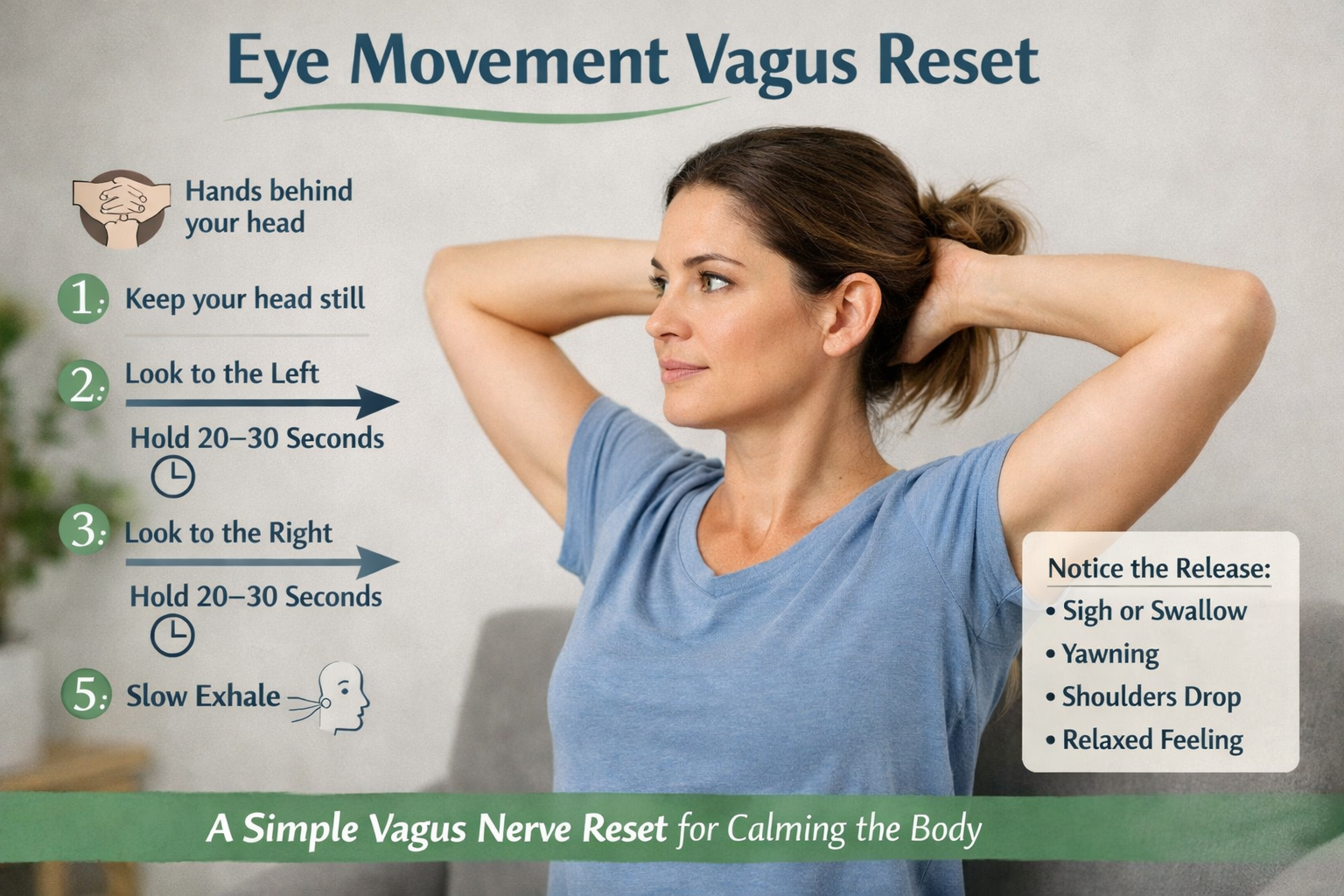
1. Sit comfortably.
Relax your shoulders and soften your jaw.
2. Interlace your fingers and place your hands behind your head.
Your elbows can relax at your sides. You’re not pulling your head—just letting the hands rest there.
3. Keep your head completely still.
4. Look only with your eyes as far to the left as you comfortably can.
Don’t strain. Just reach your edge gently.
5. Hold that eye position for 20–30 seconds.
Stop when you feel a natural shift like:
A sigh
A swallow
A yawn
Your shoulders dropping
A feeling of “release”
These are signs your body is moving toward a parasympathetic (rest-and-digest) state.
6. Bring your eyes back to center.
7. Repeat on the right side for 20–30 seconds.
8. Finish with one slow, long exhale.
That’s it. Simple, grounding, and often surprisingly calming.
What You Might Feel
Most people notice one or more of these responses:
A deep breath they didn’t expect
Warmth spreading through the body
Less tension in the neck or jaw
More saliva (a sign of vagus activation)
A softened emotional state
A clearer mind or improved focus
Some feel nothing at first — and that’s okay. Like any nervous system practice, the effects can build over time.
When to Use This Exercise
Try it when you feel:
Stressed or overwhelmed
Emotionally activated
Stuck in “fight or flight”
Before sleep
During a work break
After a difficult conversation
When your body feels tense for no clear reason
It’s also a beautiful way to reconnect with yourself throughout the day.
A Gentle Reminder
This exercise is a self-regulation tool, not a medical intervention. It does not diagnose or treat any condition. It simply invites the body into a calmer state, supporting your overall well-being.
If you are dealing with ongoing physical or emotional symptoms, always consult with an appropriate healthcare professional.
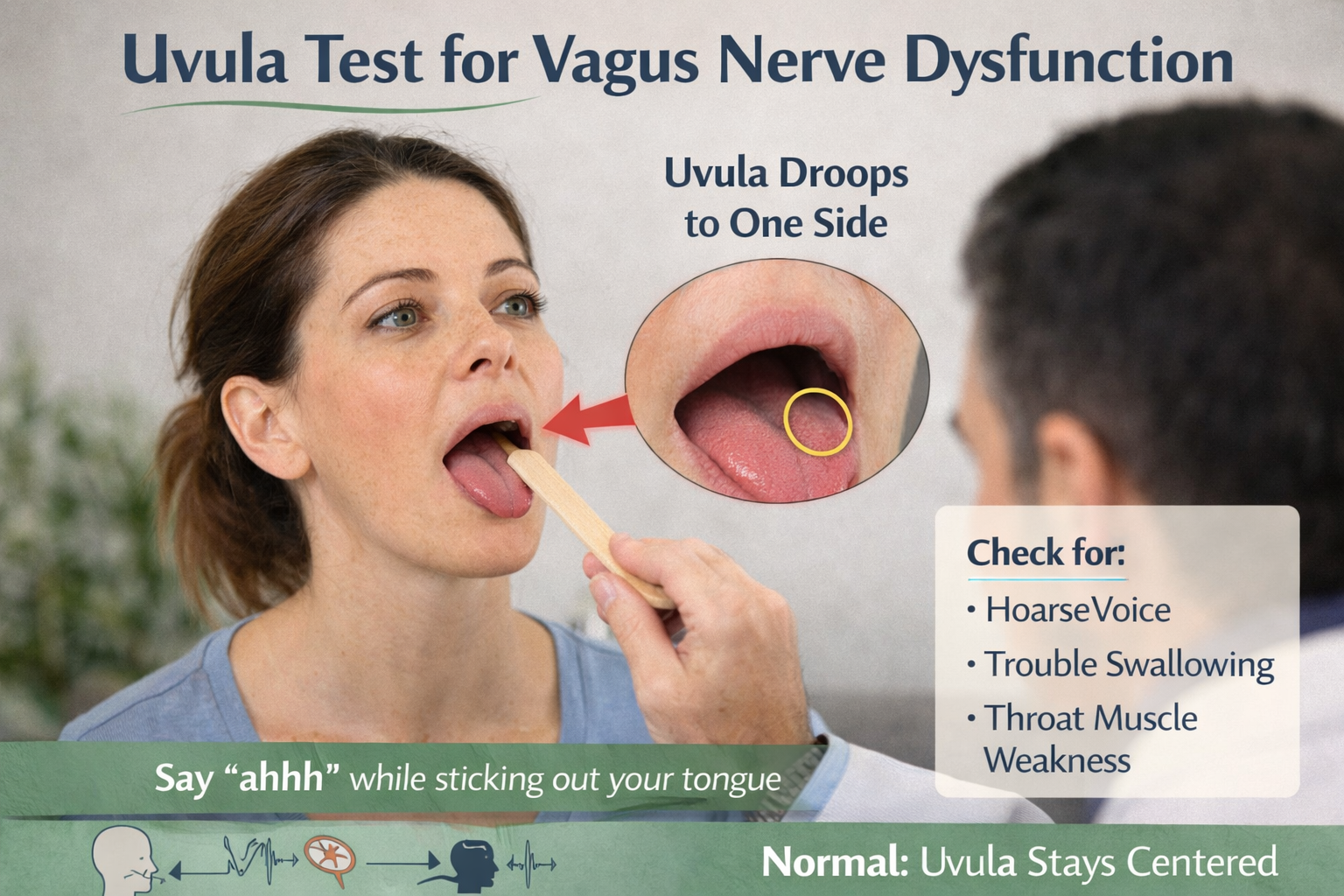
Quick Vagus Nerve Check (Uvula Test)
You can check your vagus nerve in under 5 seconds… just by looking inside your mouth.
Many of my clients are curious about how their nervous system is functioning—especially the vagus nerve, which plays a huge role in calming, digestion, breathing, and overall balance in the body.
One simple way to observe vagus nerve activity (not diagnose!) is by taking a quick look at how your soft palate and uvula move. This is a gentle, easy check you can do at home out of curiosity.
Why the Vagus Nerve Matters
Your vagus nerve helps regulate:
your stress response
your “rest and digest” state
swallowing
voice quality
breath and heart rate rhythm
When it’s functioning well, your body often feels calmer, clearer, and more connected.
How to Do the Uvula Check
Stand in front of a mirror or use your phone’s selfie camera.
Open your mouth wide.
Say “Ahhhh.”
As you do this, take a moment to observe the back of your throat.
What You Might Notice
When you say “Ahh,” the soft palate should lift evenly, and the uvula—the little hanging structure in the center—should rise straight up.
Sometimes you might see:
Even lift and centered uvula:
This suggests that the muscles influenced by the vagus nerve are activating symmetrically.The uvula pulling more to one side:
This can reflect uneven activation or tension patterns in the nervous system.Very little movement:
This may indicate fatigue, stress, or how your nervous system is currently responding.
There is no good or bad result here—just information your body is offering.
Why I Share This With You
As a Bowen Therapy practitioner, I’m always supporting clients in reconnecting with their nervous system. Observing these subtle movements can help you become more aware of your own physiology and the small signs of stress, tension, or balance.
It’s simply another way to deepen your understanding of how your body communicates.
A Gentle Reminder
This is not a diagnostic tool and shouldn’t replace medical guidance.
It’s just a quick, curious observation—one that can help you feel more connected to your body and its signals.
If you ever have concerns about swallowing, voice changes, or anything unusual that persists, it’s always best to speak with a healthcare professional.